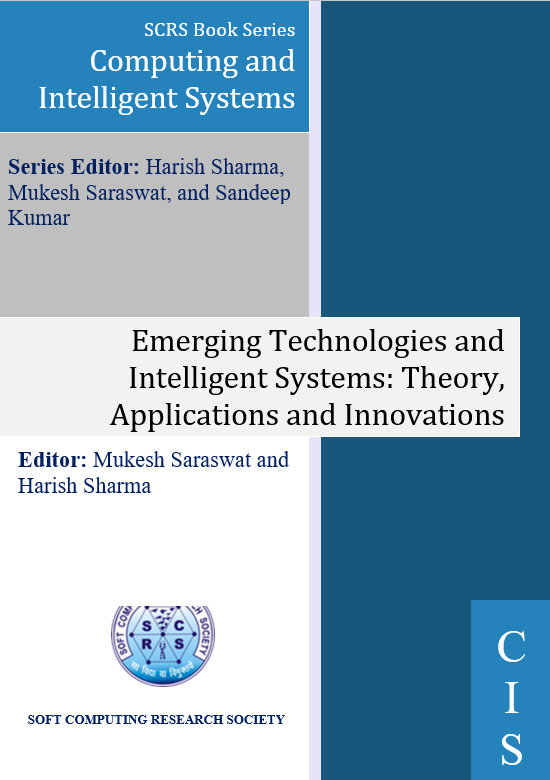
Computing and Intelligent Systems
Emerging Technologies and Intelligent Systems: Theory, Applications and Innovations
Editors: Harish Sharma and Mukesh Saraswat
ISBN : 978-81-975670-4-9
Emerging Technologies and Intelligent Systems: Theory, Applications and Innovations is an edited book that explores recent advancements in intelligent computing and emerging technologies. It covers key areas such as artificial intelligence, machine learning, deep learning, generative AI, data science, computer vision, the Internet of Things, robotics, cybersecurity, and autonomous systems. The book emphasizes innovative methodologies, theoretical developments, and practical applications across healthcare, education, industry, smart cities, and business. It also highlights future research directions, responsible AI, and interdisciplinary innovation. The volume serves as a valuable reference for researchers, academicians, industry professionals, and students interested in advancing intelligent technologies and their real-world applications.
Harish Sharma :
Dr. Harish Sharma is an Associate professor at Rajasthan Technical University, Kota in the Department of Computer Science & Engineering. He has worked at Vardhaman Mahaveer Open University Kota and Government Engineering College Jhalawar. He received his B.Tech and M.Tech degree in Computer Engg. from Govt. Engineering College, Kota, and Rajasthan Technical University, Kota in 2003 and 2009 respectively. He obtained his Ph.D. from ABV - Indian Institute of Information Technology and Management, Gwalior, India. He is secretary and one of the founder members of the Soft Computing Research Society of India. He is a lifetime member of the Cryptology Research Society of India, ISI, Kolkata. He is an Associate Editor of “International Journal of Swarm Intelligence (IJSI)” published by Inderscience. He has also edited special issues of the many reputed journals like “Memetic Computing”, “Journal of Experimental and Theoretical Artificial Intelligence”, “Evolutionary Intelligence” etc. His primary area of interest is nature-inspired optimization techniques. He has contributed to more than 65 papers published in various international journals and conferences.
hsharma@rtu.ac.in
Rajasthan Technical University, Kota
Mukesh Saraswat :
Prof. Mukesh Saraswat is a Professor and Associate Dean (Innovation) at Jaypee Institute of Information Technology (JIIT), Noida, India. Prof. Saraswat obtained his Ph.D. in Computer Science & Engineering from ABV-IIITM Gwalior, India. He has more than 20 years of teaching and research experience. He has guided 04 Ph.D. students and presently guiding 04 Ph.D. students. He has published more than 80 journal and conference papers in the area of image processing, pattern recognition, and soft computing. He was part of a successfully completed project funded by SERB, New Delhi on image analysis and one project funded by CRS, RTU, Kota. He has been an active member of many organizing committees for various conferences and workshops. He is also a Faculty in charge of Jaypee Youth Club at JIIT, Noida. He is also a guest editor of the Array, Journal of Swarm Intelligence, SN Computer Science, and Journal of Intelligent Engineering Informatics. He is one of the General Chairs of the International Conference on Data Science and Applications. He is also an Advisory Board Member of the Journal MethodsX. He is also a series editor of the SCRS Book Series on Computing and Intelligent Systems (CIS). He is an active member of ACM, CSI, and SCRS Professional Bodies.
saraswatmukesh@gmail.com
Jaypee Institute of Information Technology, Noida, India
Chapters of Emerging Technologies and Intelligent Systems: Theory, Applications and Innovations
-
The Forgotten Boundary: A Layer-Span × Underlay–Overlay Taxonomy and Gap Matrix for Multi-Layer Network Orchestration
Authors: Krishna Suman Dara, Raghuram Malpe Pai, Somesh Rahul, Amarnath G S, Shivaprasad Gali and Anudeep Rentala
Cite as: Krishna Suman Dara, Raghuram Malpe Pai, Somesh Rahul, Amarnath G S, Shivaprasad Gali and Anudeep Rentala, "The Forgotten Boundary: A Layer-Span × Underlay–Overlay Taxonomy and Gap Matrix for Multi-Layer Network Orchestration", In: Harish Sharma and Mukesh Saraswat (eds), Emerging Technologies and Intelligent Systems: Theory, Applications and Innovations, SCRS, India, 2026, pp. 1-24. https://doi.org/10.56155/978-81-975670-4-9-1
Pages 1-24
-
Self-Driving and Self-Healing Networks Using AI: Where Autonomy Is Claimed, Where It Is Evaluated, and What Runs in Production
Authors: Raghuram Malpe Pai, Krishna Suman Dara, Somesh Rahul, Amarnath G S, Shivaprasad Gali and Mohammed Kamran Syed
Cite as: Raghuram Malpe Pai, Krishna Suman Dara, Somesh Rahul, Amarnath G S, Shivaprasad Gali and Mohammed Kamran Syed, "Self-Driving and Self-Healing Networks Using AI: Where Autonomy Is Claimed, Where It Is Evaluated, and What Runs in Production", In: Harish Sharma and Mukesh Saraswat (eds), Emerging Technologies and Intelligent Systems: Theory, Applications and Innovations, SCRS, India, 2026, pp. 25-50. https://doi.org/10.56155/978-81-975670-4-9-2
Pages 25-50
-
Injection-First Staged Inference: Balancing Robustness and Reasoning Cost in LLM-Based Phishing Detection
Authors: Zhenwei Zhu and Jia Liu
Cite as: Zhenwei Zhu and Jia Liu, "Injection-First Staged Inference: Balancing Robustness and Reasoning Cost in LLM-Based Phishing Detection", In: Harish Sharma and Mukesh Saraswat (eds), Emerging Technologies and Intelligent Systems: Theory, Applications and Innovations, SCRS, India, 2026, pp. 51-67. https://doi.org/10.56155/978-81-975670-4-9-3
Pages 51-67
-
Threshold, Not Architecture: Where Visible-Error Suppression Actually Comes From in Consumer-Facing AI
Authors: Somesh Rahul, Raghuram Malpe Pai, Krishna Suman Dara, Mohammed Kamran Syed and Anudeep Rentala
Cite as: Somesh Rahul, Raghuram Malpe Pai, Krishna Suman Dara, Mohammed Kamran Syed and Anudeep Rentala, "Threshold, Not Architecture: Where Visible-Error Suppression Actually Comes From in Consumer-Facing AI", In: Harish Sharma and Mukesh Saraswat (eds), Emerging Technologies and Intelligent Systems: Theory, Applications and Innovations, SCRS, India, 2026, pp. 68-87. https://doi.org/10.56155/978-81-975670-4-9-4
Pages 68-87
-
POLARIS: Policy-Orchestrated Adaptive LLM Inference Across Heterogeneous
Authors: Somesh Rahul, Krishna Suman Dara and Raghuram Malpe Pai
Cite as: Somesh Rahul, Krishna Suman Dara and Raghuram Malpe Pai, "POLARIS: Policy-Orchestrated Adaptive LLM Inference Across Heterogeneous", In: Harish Sharma and Mukesh Saraswat (eds), Emerging Technologies and Intelligent Systems: Theory, Applications and Innovations, SCRS, India, 2026, pp. 88-108. https://doi.org/10.56155/978-81-975670-4-9-5
Pages 88-108
-
Explainable AI for Medical Diagnosis Web Application using Deep Learning and Machine Learning
Authors: Likhith K Poojary, Poormima B V and Mustafa Basthikodi
Cite as: Likhith K Poojary, Poormima B V and Mustafa Basthikodi, "Explainable AI for Medical Diagnosis Web Application using Deep Learning and Machine Learning", In: Harish Sharma and Mukesh Saraswat (eds), Emerging Technologies and Intelligent Systems: Theory, Applications and Innovations, SCRS, India, 2026, pp. 109-119. https://doi.org/10.56155/978-81-975670-4-9-6
Pages 109-119
-
HELIOS: Failure-Aware Distributed Scheduling for Heterogeneous AI Services
Authors: Mohammed Kamran Syed, Anudeep Rentala, Somesh Rahul, Raghuram Malpe Pai and Krishna Suman Dara
Cite as: Mohammed Kamran Syed, Anudeep Rentala, Somesh Rahul, Raghuram Malpe Pai and Krishna Suman Dara, "HELIOS: Failure-Aware Distributed Scheduling for Heterogeneous AI Services", In: Harish Sharma and Mukesh Saraswat (eds), Emerging Technologies and Intelligent Systems: Theory, Applications and Innovations, SCRS, India, 2026, pp. 120-141. https://doi.org/10.56155/978-81-975670-4-9-7
Pages 120-141